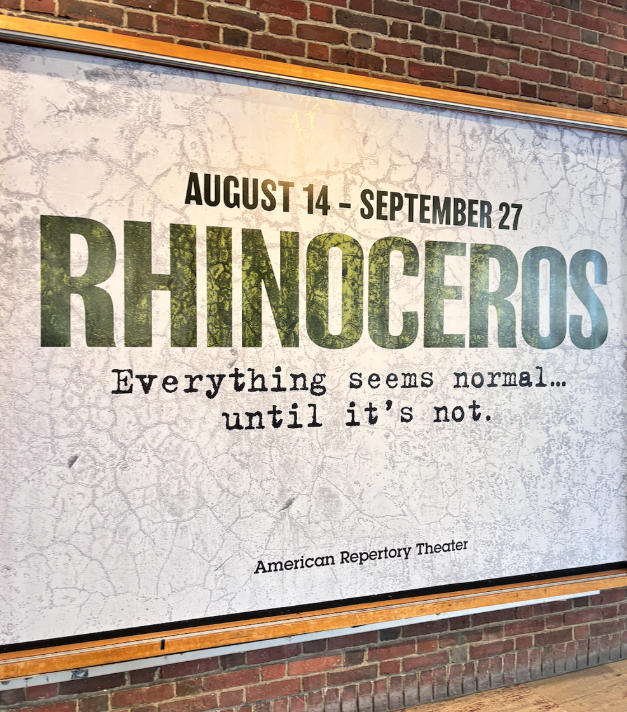
Challenging the societal hierarchy on a mundane Sunday morning, the absurdity of a lone rhinoceros rampaging across town forces citizens to choose whether they will conform to the absurd or cling to their humanity in the American Repertory Theater’s (ART) adaptation of the timeless play Rhinoceros, directed by Diane Paulus.
Originally written by Eugène Ionesco in 1959 in response to the rise of fascism in Romania prior to World War II, this new translation of the interwar period piece commences ART’s 2026-27 season with a reminder for audiences to value their authenticity amongst society’s pressures of conformity.
Malden returns for its fourth season as a part of ART’s Lavine Learning Lab, a collaborative and social-emotional learning-based initiative that fosters community amongst public high schools in the greater Boston area through production-based workshops.
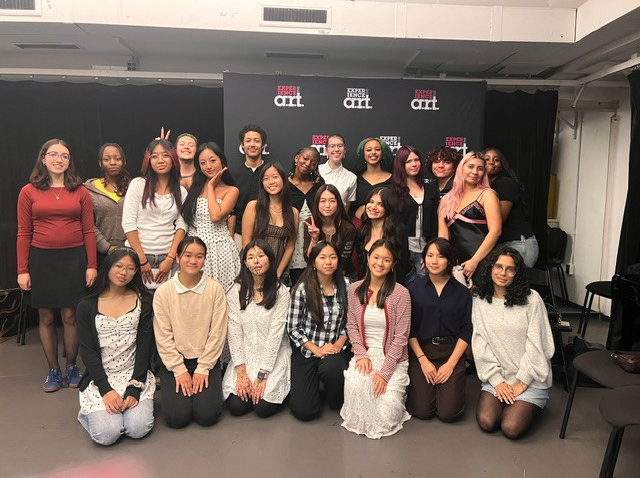
On Wednesday, September 16th, Learning Lab Lead Vahdat Yeganeh initiated the first workshop by introducing one of the show’s major themes: absurdism. After participating in a “one word story” exercise to get comfortable with the realm of the unexplainable, students were prompted to get into pairs and create a skit where the only words spoken were numbers.
Audience members had to determine what the relationship between both actors was based solely on the actors’ body language and delivery choices, a similar technique that would be utilized in the show.
Senior Joan Diaz Vargas described the impact of learning how “absurdism is inherently funny,” which prepared him for the type of comedy used in Rhinoceros.
The workshops aimed to explore the show’s essential question: What does it mean to be a “rhinoceros”?
On the following Tuesday, September 22nd, students arrived at the Loeb Drama Center at Harvard University, where they would be participating in a pre-show workshop alongside Boston Latin Academy. To acclimate themselves to animalistic mannerisms, students were instructed to interpret pre-written skits while embodying a random animal of their choosing.
Students eagerly filed into their seats to watch the production they had been learning about and anxiously awaiting, the anticipation mounting further due to the star-studded cast including John Tuturro, Paul Giamatti, and Tatiana Maslany.
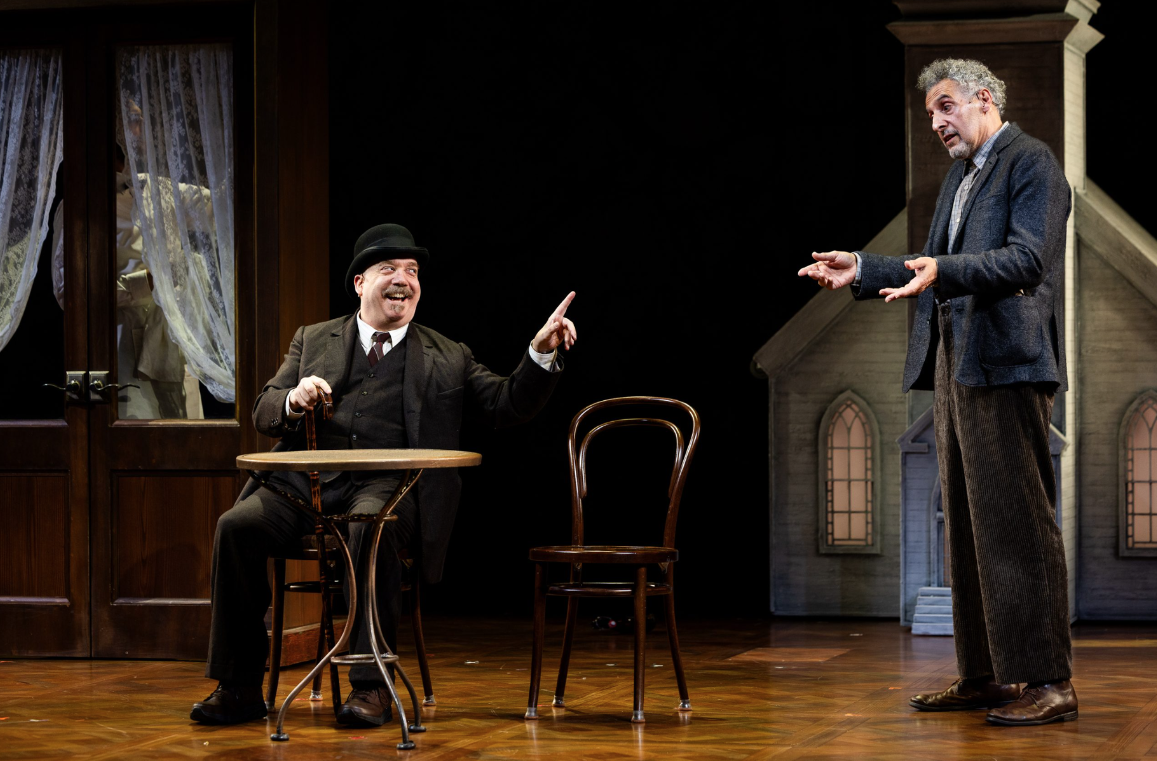
The avant-garde play opens on a quaint French town square, where Bérenger, played by Tuturro, is joined by his closest friend Jean, played by Giamatti, to quarrel over Bérenger’s existential hangover-induced dread. Suddenly, a rhinoceros rages through the town, putting an abrupt halt to the townsfolk’s calm morning.
The stampede baffles Jean, but the rest of the town seems to be unbothered by the rarity of this occurrence and brushes it off as a hoax. However, once the rhinoceroses start multiplying across town, everyone is forced to take notice.
The herd mentality begins to invade everyone’s daily lives, as seen through the shift in an idle office conversation where Bérenger and his coworkers debate the ethics of becoming a rhinoceros while they watch the inhuman transformations spread like an epidemic.
At the end of the first act, the ultimate betrayal takes place as Bérenger watches Jean transform in front of his very eyes; in a fit of snorts and grunts, Jean thrashes around the bedroom, demolishing everything in his path before he locks himself in the bathroom and breaks through the door that Bérenger is waiting behind with his horn, solidifying the loss of his friend.
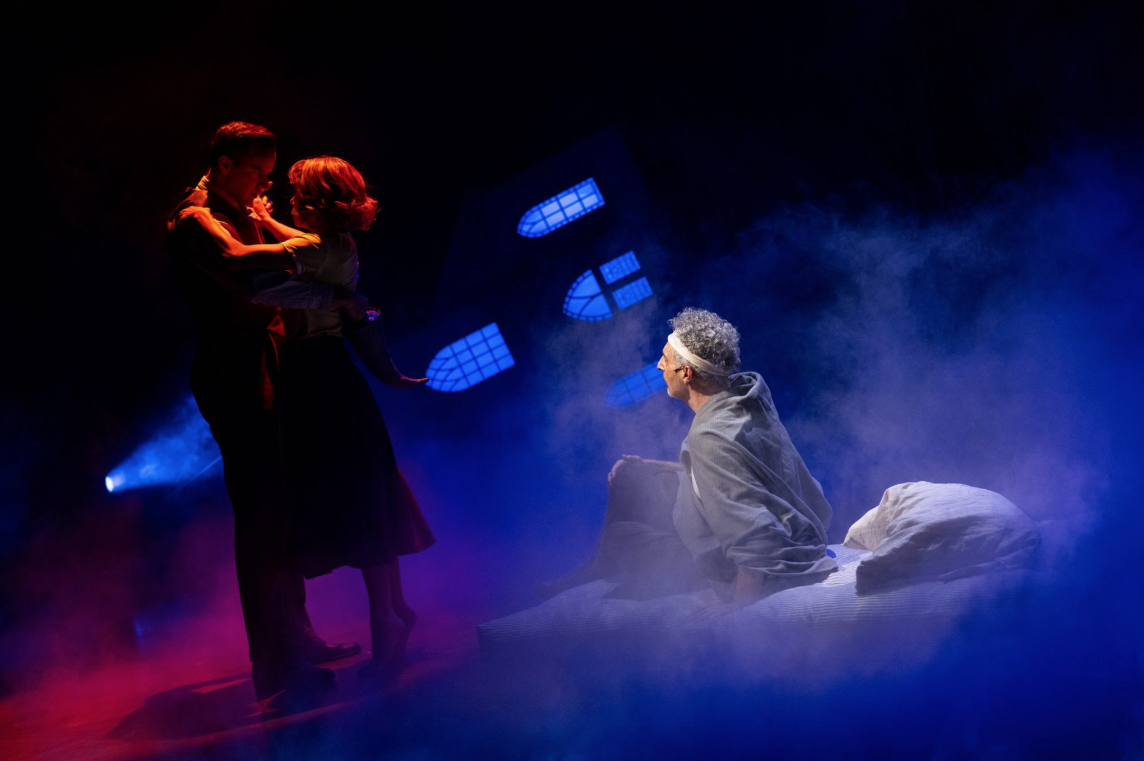
Bérenger is forced to accept that his friends and peers have moved beyond morality and that humanism is now outdated. To prevent him from falling victim to this mob mentality, he opens the second act appearing barricaded in his bedroom.
Bérenger’s coworker Daisy, played by Maslany, visits him to check on his well-being and finds Bérenger in a state of disarray. The pair grapples with the reality that the rhinoceros population has become the majority, forcing them to accept that buildings getting trampled over and mass destruction is the new norm.
As they watch the remainder of their coworkers join the herd, Bérenger and Daisy are the last two humans standing. They rejoice that the love between them can be enough to drown out the noises of the rhinoceroses that have overtaken society, but Daisy ultimately falls victim to the ideology that they are beautiful and naturally free, becoming a rhinoceros herself.

In the rubble of his lost love, friendships, and apartment, Bérenger is adamant on the fact that he will not conform. The back curtain was lifted to reveal a rhinoceros built out of bed frames slowly approaching Bérenger, the first and last time a rhinoceros was shown on stage and not represented through sound effects.
In the last workshop, students reflected on the show’s theme of conformity to present-day societal standards. “Societal norms pressure us to become something we are not, all because we are longing to fit in and seem cool,” sophomore Emily Chia noted.
Senior Grayson Herrera elaborated on the show’s essential question, stating that the act of becoming a rhinoceros can be connected to “this current situation in the U.S. I think, ultimately, what happens is no one really has a choice in what they do, unless they have been given choice through education.”
Rhinoceros teaches audiences the importance of thinking for oneself, no matter how tempting hiding behind mass opinion can be.
About the Author