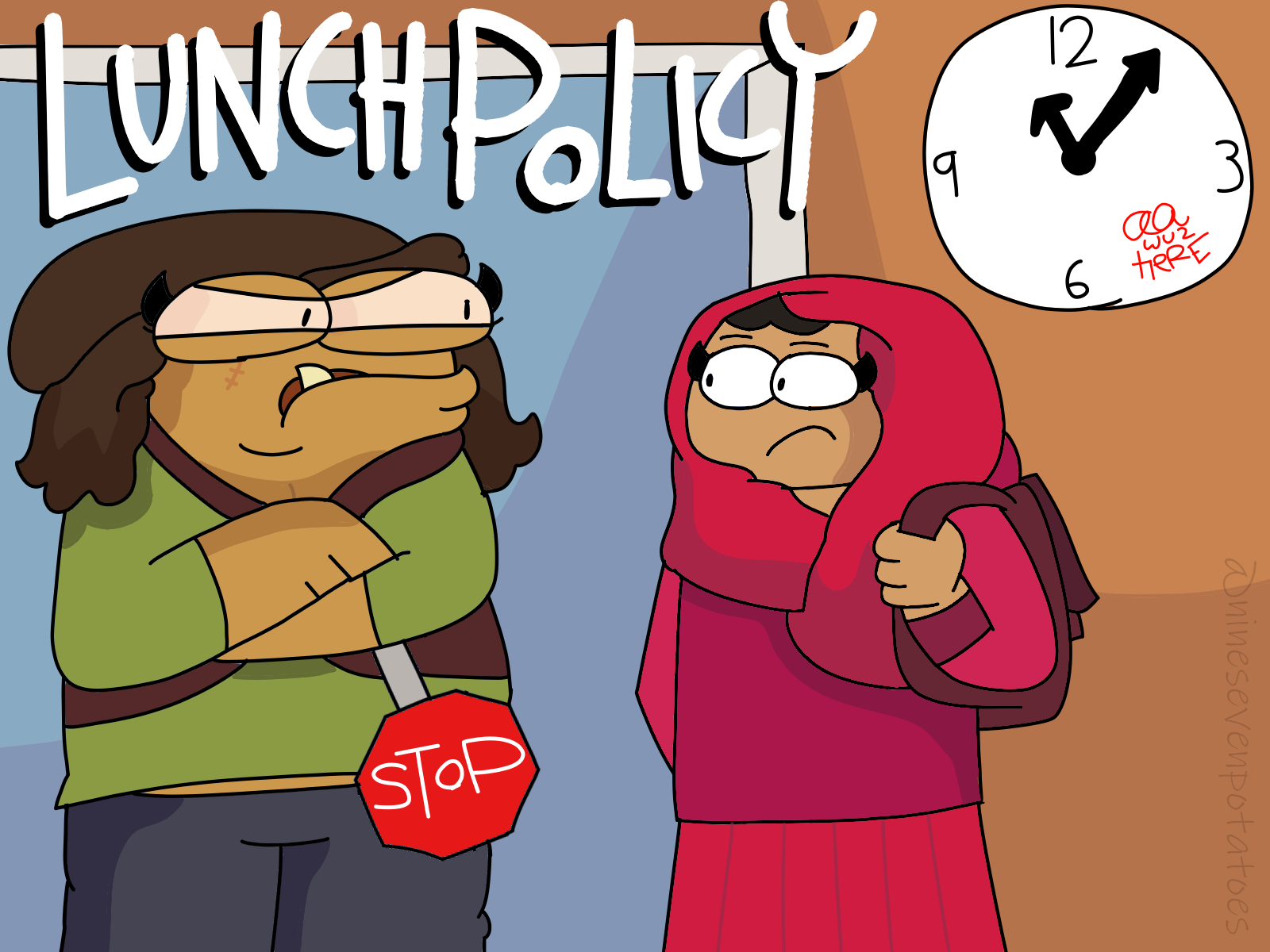
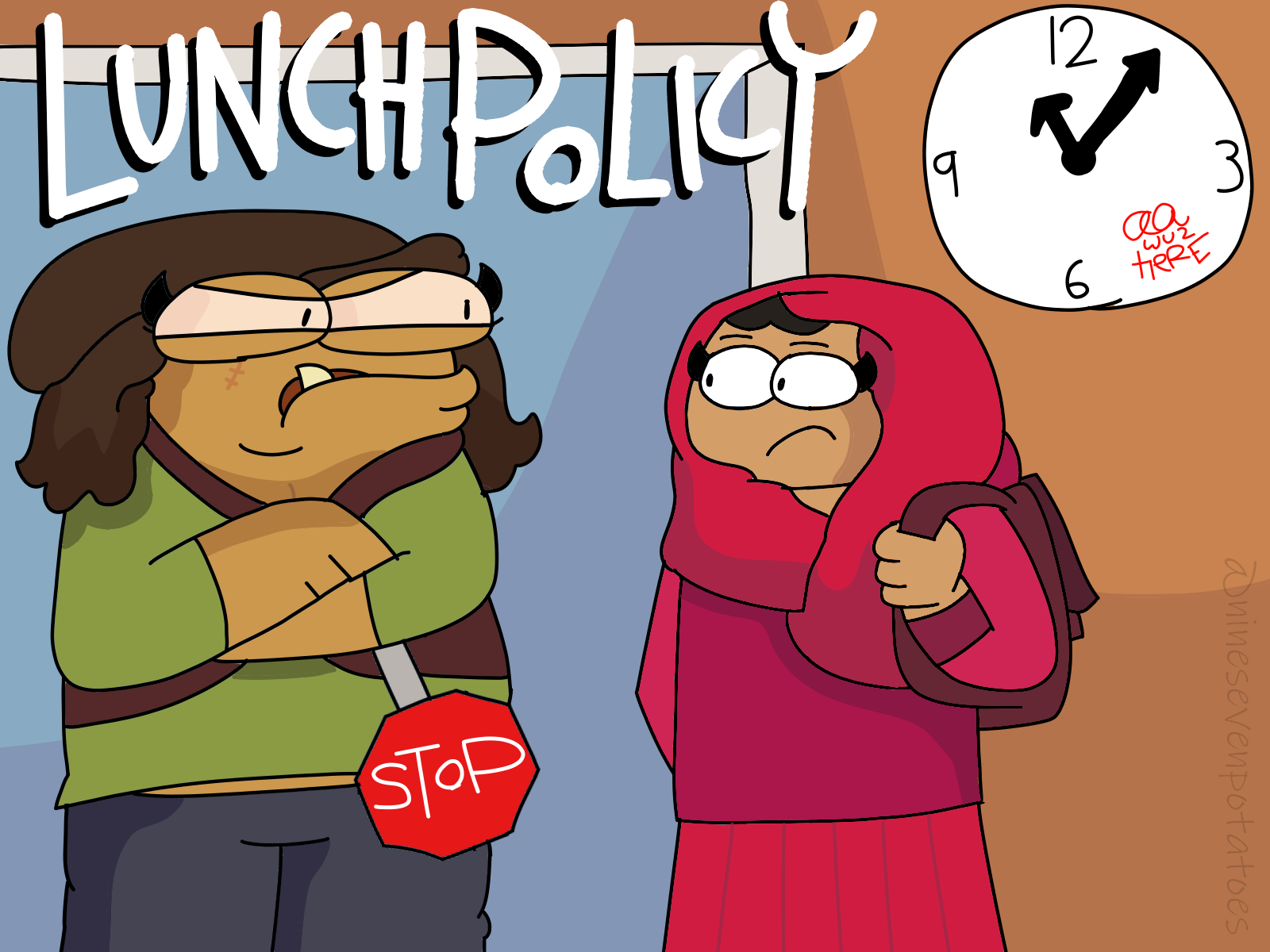
*RINNGGG* The bell rings as you are collecting your things, trying to get to class. In front of you stands a cluster of students all with the same goal, but instead, they are being told to remain within the cafeteria’s perimeter. The result of this new policy has sparked a heated debate throughout the school.
As of September, a new lunch policy has been implemented at Malden High School, in which students are not permitted to leave the cafeteria or courtyard during their assigned lunch times without a pass. This rule was created to prevent students from wandering the halls and disturbing other classes. Since then, both students and teachers have expressed a variety of opinions on the policy.
Overall Opinions
At the start, many agreed to have “mixed feelings” on the policy, stating how they thought it was something they had to gradually adjust to, while others shared that the policy was “not necessary, but beneficial.” Sophomore Sofie Rivera claimed that she initially thought, “Why?” From her perspective, it felt “unnecessary,” considering how last year, things felt they “were fine as is.”
Teacher Patrick Healey also shared his mixed emotions, noting that while the cafeteria can be “crowded and loud,” it can also be overwhelming for some students; the alternative—students overflowing into the hallways—can be just as chaotic for teachers trying to conduct class. “Sometimes kids just need a break from all the noise,” Healey said, “but at the same time, the overflow of kids in hallways during lunch can make teaching harder.”
On the other hand, some students have responded positively. Sophomore Lasean Milton remarked that the rule “is not all that bad” and has led to “a more controlled environment.”
Joshua Sellers, a teacher who supervises the stairwell during lunch, supported the reasoning behind the rule and said, “Students need to stay in the cafeteria during their lunch.” He continued, “Generally, I think students having an assigned place to be is good, and fewer students in the halls during class is also good.”
Teacher Paul Doucette, who is also responsible for ensuring students have a pass to leave the cafeteria, explained how, at first, he “did not love that idea” because he does not enjoy having to be “mean to kids” and “tell them they can’t go certain places.” Eventually, Doucette found that he actually really likes the policy as a teacher.
While not everyone agrees on the necessity of the new policy, many acknowledge that it had a noticeable impact, both positive and negative. Whether it is about maintaining order or limiting freedom, it is clear that the policy has shaped the daily rhythm of school life in ways that everyone is still adjusting to.
Pros
Many interviewees had primarily focused on the advantages of the policy. Sophomore Vicky Ye expressed that the new policy helped “clear out the hallways during class time,” making it “less noisy” and “disturbing” for those who are in class.
Rivera pointed out that “the biggest benefit of keeping kids in the lunchroom is definitely knowing where everyone is,” which contributes to a greater sense of control and safety.
Similarly, Milton emphasized how the policy “helps centralize supervision and maintain order,” something that becomes harder to achieve when students are scattered across the school during lunch.
Healey agreed, stating he believes “the biggest advantage is maintaining calmness in the hallways.” He also noted the practical benefit of being able to locate students quickly if they are needed. “It helps administrators find someone if they’re being picked up or need to be spoken to. Overall, it helps keep things organized.”
For many teachers and students, the benefits of the policy lie in its structure. From a calmer school environment to increased safety and accountability, the rule has created a more organized space—and for some, that is a welcome change.
Cons
Despite having benefits, some have described the downsides of the rule. Students like Ye and sophomore Hana Wanas had claimed that although making it so that the hallways are “clear” and “quieter,” the policy has also caused her to run late to class “quite a few times.”
Sophomore David Ruprecht echoed this concern, saying, “I’m pretty comfortable with the new rule—I don’t really have the desire to go upstairs during lunch since all my friends are with me, but it can be annoying when you’re trying to get to class early and staff won’t let you through. Then you’re just stuck in a crowd with everyone else trying to do the same.”
Healey acknowledged that the policy may not benefit everyone. “I don’t think it’s helpful for students who use their time responsibly—like those who want to get to class early, meet with a teacher, or grab something from their locker. For those students, this policy doesn’t work.”
Ruprecht, concerned about student autonomy, said, “I feel like this policy takes away student freedom. Last year, we were able to go upstairs without any issue. Now it feels like we’re being restricted for no reason.”
Rivera agreed, suggesting that the restrictions might be counterproductive. “Its biggest drawback is that having so many restrictions makes kids more likely to want to break the rules just to go upstairs,” she said.
Healey added that overly controlling policies can impact student growth: “The biggest drawback is that it removes the chance for students to show maturity. If we treat kids like adults, they’ll often rise to the occasion. But if we treat them like children, they’ll act like children. High schoolers deserve some trust.”
For every student who feels more secure, there’s another who feels boxed in. The policy may offer structure, but it also raises questions about student independence and fairness—issues that could impact school culture in deeper ways over time.
Experience
Daily, students and those on stairwell and hall monitoring duty have had to adapt their usual day-to-day routines according to the lunchroom policy.
Sellers claimed that he “has not noticed a major change,” but “there are still times where there are kids in the hallway who are being… distracting, and I presume it’s because they have lunch.”
Healey observed, “I think it’s beneficial for students who have class during third or sixth period. The halls are noticeably quieter, and that’s a big improvement.” However, he also noted the added responsibility: “I used to have bathroom duty—this is easier in some ways. But it also feels strange telling good kids they can’t go to their lockers. It puts staff in a tricky position. So in that sense, it’s made my job a little harder too.”
Junior Jana Wanas expressed how her overall lunch experience “did not change significantly.” She expressed how the only difference was “not being able to leave early to go to my locker or next period,” but other than that, “the policy did not change much.”
While the daily logistics may not have changed drastically for everyone, the policy has reshaped the flow of student and staff movement during lunch. For some, the shift has brought peace; for others, it has added small but persistent obstacles.
Effectiveness
Despite the value the student body and staff hold in their perspectives, there is still an important question to ask: Has the intention of the policy been fulfilled?
Healey offered a more nuanced take: “Is this policy necessary? There were definitely too many students in the hallways last year, and this addresses that. Could there be a better solution? Maybe. From what I’ve seen, though, it seems to be going well.”
Milton believes the policy is doing what it set out to do. “This policy helps reduce hallway tension by limiting student movement during class,” he said. “It definitely decreases noise and makes for a more focused environment for students who are still in class.”
Rivera, however, questioned how effective the rule really is. “Some stairwells are guarded, but others are open. Depending on where you are, it’s easy to break the rules—which kind of makes the whole policy pointless.”
Sellers believes that, despite being beneficial, the policy must be enforced in a more “consistent manner.” He explained how when “hall monitors and house principles have things come up, like urgent things that they have to attend to,” they are busy tending to the other situation, resulting in a lack of control in the halls because “they can’t walk around their area of the building to tell students, hey, we’re not sitting in the hallway, when things come up and they don’t have time to do that.”
Sophomore Wafia Saruwar claimed that the policy is conducted, but not in a fair manner. She noticed how some staff responsible for supervising the stairwells might recognize some of their students, which “could lead to them being biased because they know them, and they could just let their students leave the cafeteria.”
The policy has clear effects—fewer students in the halls, less noise, and more structure. But questions remain about how consistently and fairly it’s applied. If a rule works only some of the time, is it really working?
Suggestions for Improvement
Despite the variety of perspectives, many have suggested that there are certain areas of improvement in which the policy should be refined to properly benefit the student and staff.
“We need more places to eat lunch,” Rivera suggested. “The cafeterias get crowded, and when the courtyard closes in winter, it’ll be worse. If we had more options, I think students would be happier.”
Healey proposed adding more flexibility to the policy. “Maybe we could open more spaces for students who need a quieter place to eat. As it gets colder, the cafeteria will be overcrowded, and that will stress some students out.” He also mentioned a possible solution already in practice. “I let students eat in my classroom during lunch because I have prep for both periods,” he said. “If we identified teachers in each building who are willing to do the same—say, one in Boyle, Jenkins, Holland, and Brunelli—those could become known lunch spaces. That might be a good middle ground.”
Sellers explained how, while he hasn’t thought of any different approaches, it would “be great if we had more staff to monitor the hallways and make sure students are going to where they’re supposed to be going.” He explained how the policy itself does not need to change, but for “consistent enforcement of the policy and consistently having students only use the hallway to move from one place to the other, we would probably need more hall monitors” to guarantee that there won’t ever be any students sitting in the hallway during a class period.
The solution may not lie in removing the policy, but in refining it. More spaces, better communication, and stronger enforcement could help bridge the gap between structure and flexibility—making the policy work for more people.
Despite the reason for the policy being clear, the reception among staff and students has certainly been anything but unanimous.
While many appreciate the order it brings, others feel it restricts student independence. As the school year continues, it might be worth considering ways to keep the structure—without sacrificing students’ trust.
About the Author