Priscarla Villefranche also contributed to this article.
Your favorite song, “Pretty Girl” by Clairo, just started playing. You noticed a guy drinking his matcha and bobbing his head to the beat of your song. He glances over to you, and you realize that you were playing your music a bit too loud.
Music is everywhere: at parties, malls, and stores; it seems as if there’s always background music. “So, why not continue it?” computer science and Math teacher Paul Marques expressed.
But, the question becomes, does playing music actually help keep students focused and lead to productivity?
For many students, music is used as a concentration tool. “Whatever noise I hear, like laughing or tiny noises, I end up getting distracted,” shared sophomore Andrew Souders. He continued, “Music helps block out those distracting sounds.”
Some teachers are in agreement. U.S. History teacher Courtney Braz often plays music, movies, or background videos in her classroom. “It’s hard to sit in a room that’s totally quiet and work,” Braz explained.
English teacher Pasquale DiBenedetto takes song recommendations from students in addition to dimming his LED lights to create a cozy atmosphere in his room. “It’s a nice combination between the lights and the music,” DiBenedetto commented.
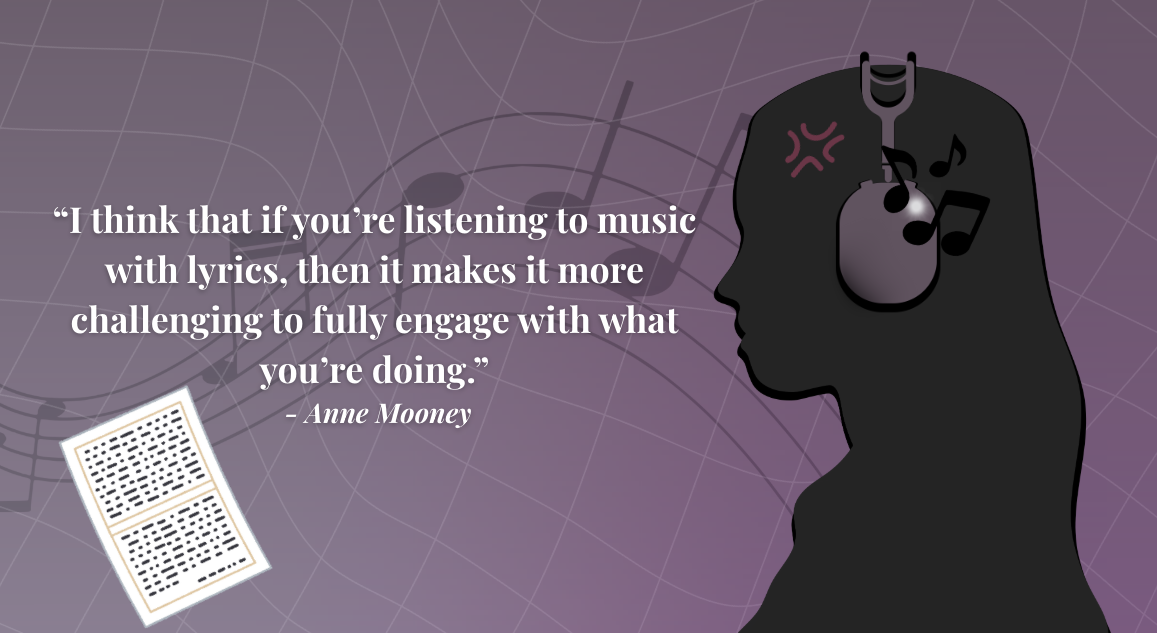
Still, not everyone finds music playing while working to be helpful. English teacher Anne Mooney admits she has difficulty hearing her own thoughts since she “can’t tune music out.”
There is research that backs up Mooney’s experience, as music can be a huge distraction to your work efficiency. Studies from the National Institutes of Health (NIH) show that listening to music with lyrics can lead to a decrease in learning performance due to the mind’s need to process them.
Psychologists Richard E. Mayer and V.K. Sims found that since the working memory is highly limited, people are not able to process comprehension tasks and background music simultaneously. However, a study by Christopher A. Sanchez and Jennifer Wiley in 2006 suggest there may not be direct evidence correlating background music with working memory capacity, negatively or positively.
Other studies suggest that the tempo and intensity of music matter. A 2002 study by Gabriela Husain found that depending on the tempo of a song, music can increase or decrease overall alertness. Husain added that listening to background music does not have a direct effect on cognitive abilities; instead, it affects them through the stimulation of mood and exhilaration, known as the Mozart effect.
Sophomore Sofia Rivera expressed how music can be a huge distraction for her, as she gets so immersed in her music that she gets “an urge to act out” with her hands and facial expressions and sing along.
When it comes to students keeping their earbuds in during lessons, most teachers oppose it. Mooney highlighted that it is a good “practice” not to be reliant on headphones, as during standardized testing, such as the “MCAS and SATs,” that is not an option. Additionally, Braz explored the concept of being “present in the conversation,” where if someone else is talking, having earbuds in can prevent that connection.
In contrast, many students feel differently; wearing headphones helps sophomore David Ruprecht complete his work and helps him focus. “It gets me to finish my work two times faster than having no music on,” Ruprecht expressed.
So, what should you listen to if you think music does help you focus? According to Healthline, music that doesn’t contain lyrics and remains slow and instrumental is best to play while concentrating on your work. Braz suggested playing classical, trance, and EDM music. “It gets you in this groove to produce work,” she noted.
Whether you’re studying, walking down the street, or drinking your matcha, music will always be there. Luckily, there is an endless amount of songs that you can choose from. The key is to find the kind that keeps you focused and does not fade away.
About the Author