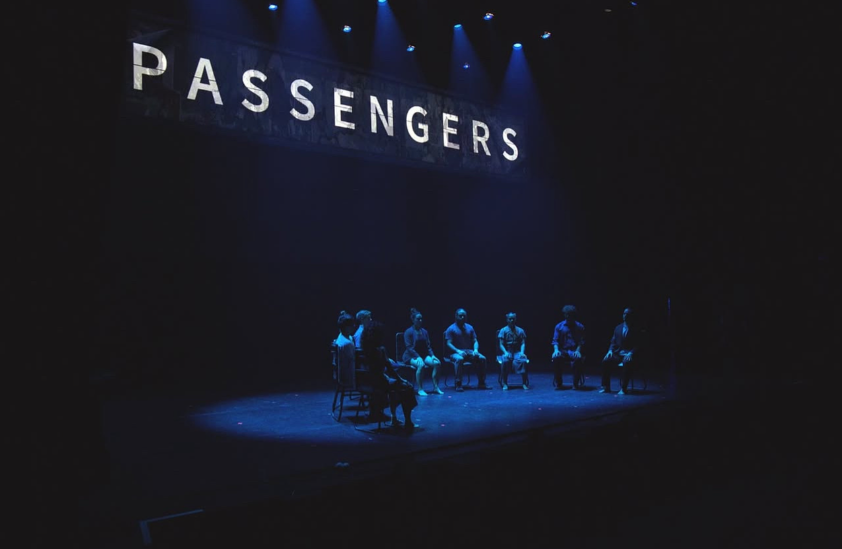
Defying the bounds of athleticism and physicality through a transformative journey of acrobatics and music, the 7 Fingers circus troupe’s production of Passengers, directed by Shana Carroll and presented by the American Repertory Theater (ART), immersed students in a depiction of life’s ever-changing landscape through a train ride.
Malden is one of the six public high schools that is a part of ART’s Lavine Learning Lab–a collaboration-based initiative that fosters inquisitiveness and social-emotional learning through student workshops on ART productions, entering its third season with the program.
Commencing the 2025-26 season, Passengers visits Boston through the ART with its third cast of the show. By analyzing the development of complex relationships between the ten passengers on the same train, the student workshops strive to answer the show’s essential questions: In what ways does life happen while in transit, and is the journey truly more important than the destination?
A week before the show, on Wednesday, September 17th, ART students were excused from their third-period classes to participate in an immersive workshop hosted by Learning Lab Lead Vahdat Yeganeh. Held in the Jenkins Auditorium, Yeganeh led the students through various exercises that focused on a key aspect of the show–the importance of building an ensemble.
“Our workshop…taught us a lot about trust and working with those around us, which I think would help alleviate some anxiety we would have when watching the show, because that show was all about trust,” sophomore Minerva Davenport explained.
The introductory workshop aimed to enlighten students on how significant eye contact, body language, and vulnerability are within an ensemble, especially while working on a show such as Passengers. Senior Noha Ahmed described how performers “couldn’t really talk” to communicate cues during intricate acrobatic scenes.
As students reflected on the skills they acquired together, the day of the show snuck up on them. On the afternoon of September 24th, students boarded a shuttle bus that would be taking them to the Loeb Drama Center at Harvard University, where the show would be displayed later that evening.
Upon arrival, students had the opportunity to briefly observe the cast of Passengers rehearsing their skills before the show. Christelle Vitupier, Resident Director and Tour Manager, greeted the students and explained the show’s history on tour as well as the current cast’s preparation process in the days leading up to that night.
Students were then directed to a dance studio where they would be eating a complimentary dinner and participating in another workshop before the show. Cambridge Rindge and Latin High School (CRLS), another high school that is a part of the Lavine Learning Lab, joined Malden for the pre-show activities, and after many boxes of pizza were consumed, the second workshop began.
In this workshop led by Learning Lab Assistant Ariella Kasmer-Jacobs, students were asked to walk and “fill the space” of the studio while making intentional changes in their tempo, topography, and spatial relationships. Davenport described the purpose of this exercise was to “show us how you might all be going to the same place, but how you get there is different.” Students were also prompted with different circumstances while filling the space so they could observe how their motivations affect their physical choices.
Shifting the focus to the theme of the different journeys we take through life, students split into groups where they were prompted to create two tableau scenes depicting any journey, while paying special attention to how they transitioned between still images. Ahmed expressed that this exercise “really resonated with ‘Passengers’ because we did something similar to what they did in a way,” as tableau was commonly used throughout the show.
The time to see all of the workshop preparations come to fruition finally arrived as students were given tickets and escorted back into the theater. In the ART tradition, two Learning Lab students introduce the show to the audience by presenting a brief “welcome.” Senior and ART Teen Council member Julia Cardoso represented Malden as she completed the welcome alongside a student from CRLS.
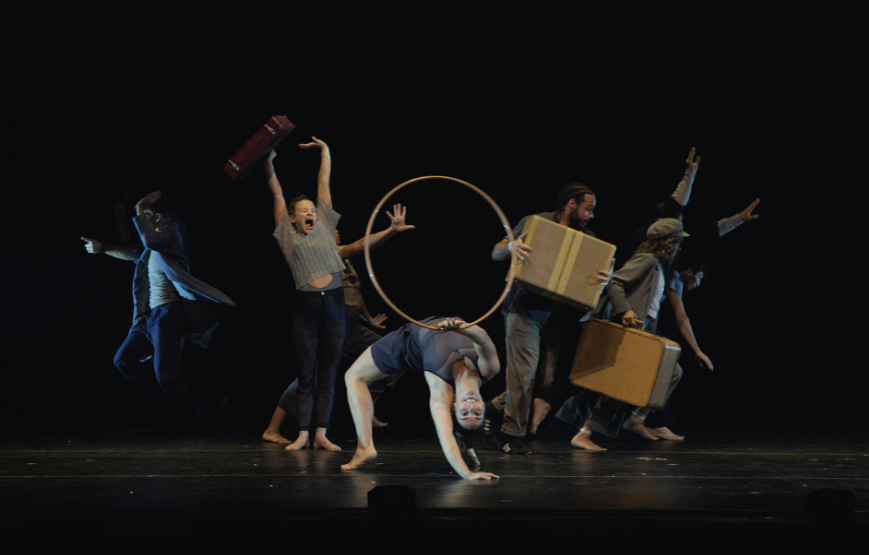
A singular breath–in and out, in and out, transformed into a chorus of synced rhythmic breathing, introducing the ensemble of passengers swaying to the lull of the train assembled of chairs. The music swells, and the stage is struck to now display a bustling train station; passengers crossing each other via tumbling passes with carry-ons in hand and performing hula hoop illusions.
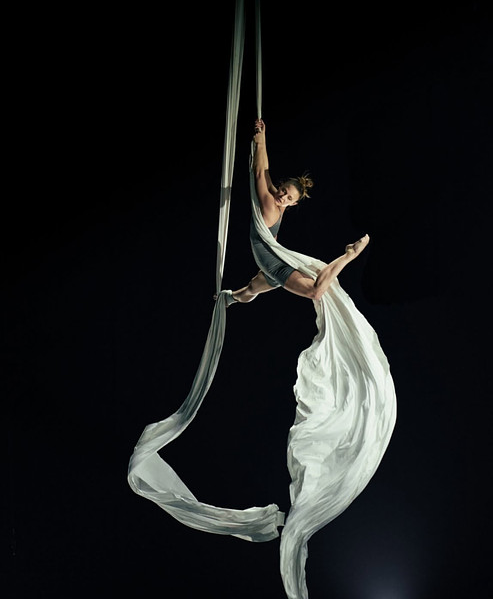
While each passenger frantically organizes their carry-on, an aerialist removes silks from their bag and ascends into the air, easing into an intense and emotionally packed routine supported by a beautiful soundtrack.
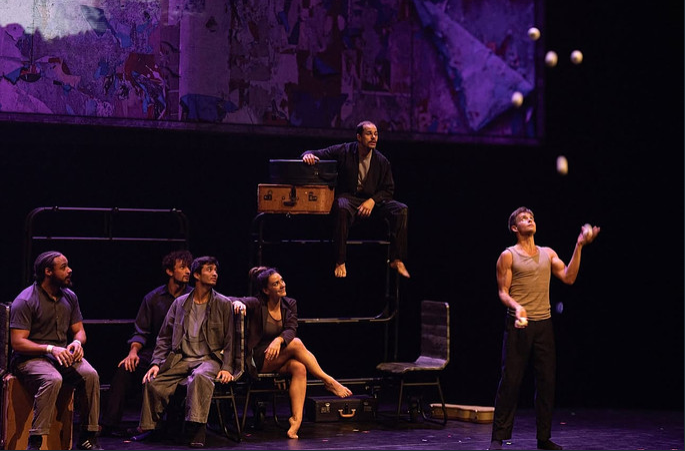
Transitioning back to the train, the passengers seem to be individually focused on their own tasks and pastimes, until one rises from his seat and begins juggling throughout the aisle. Irritated at first, his fellow passengers complain, yet provoke him by rolling more balls his way. Despite the increasing number of balls, the passenger seamlessly juggles them and leaves both his audience on the train and in the theater in awe.
Two characters who were previously bickering on the train ride then embark on a trapeze together to perform a passionate duet depicting the complexities of their relationship. “I was scared out of my mind, especially in the trapeze scene because of that drop,” Davenport exclaimed.
As the storyline had been driven mostly through music, the only dialogue-driven scene was nothing but intentional to the message of the show. The passengers assemble, and a performer delivers a monologue to the rest of the group about Albert Einstein’s theory of relativity. He references Einstein’s “Relativity Train” thought experiment, where two lightning strikes are observed from the front and back of a train by someone on the train and someone on the platform.
The finding of an observer’s motion altering their perception of time is connected back to the show and the ensemble’s performance of gravity-defying superhuman motions, displaying how their perception of time as they move through their journeys is constantly shifting based on each performer’s impact on one another.
While it’s impossible to capture an appropriate description of the intensity and emotion of each spectacle during the 90-minute show, ending just as it began, the passengers arranged their seats in a semicircle and fell back into their rhythmic breathing before the lights blacked out, signaling the end of the show.
The audience erupted in applause, giving praise to the ensemble troupe and the spectacle they had just had the pleasure of seeing. ART Teacher Leader and Play Production teacher Ariana Messana described the show as “absolutely mesmerizing and, as a teacher, very inspiring. Getting to see a show that had so many different talents being displayed for an audience was not just impressive, but it also helped me as a director get ideas about things that I could do in my theater with my students.”
Yeganeh returned to MHS for a third and final reflective workshop on Wednesday, October 1st, where students participated in physical exercises that channeled the emotions they had while watching the show. In a final group discussion, each student went around the room and explained what their journey would look like and answered the show’s essential question.
The group came to the consensus that the journey is more important than the destination for a plethora of reasons; the journey is most impactful through the lessons one learns and the connections one makes with those they encounter, rather than reaching a definitive destination.
Passengers teaches us that while you may be going in the same direction, we each have our own motivations for our individual journeys and indirectly impact the journeys of those around us.
So next time you take the T, think twice about your fellow passengers.
About the Author