March marks the arrival of spring, longer days and a shift in weather, but it also carries a deeper significance. Alongside many notable days such as St. Patrick’s Day and Pi Day, March is recognized as Women’s History Month: a time dedicated to honoring the achievements, resilience, and lasting impact of women throughout the past, present, and future. This month is an opportunity to acknowledge the contributions of women that history has too often overlooked, while continuing conversations about representation, equality, and progress.
Women have played a crucial role in shaping societies worldwide by contributing to numerous fields such as politics, education, art, science, and more. Despite these contributions, their achievements have not always been equally recognized or documented, often having historical documents centered around male figures, leaving the accomplishments of women underrepresented.
Gradually, efforts have been made to bring their stories into the limelight, emphasizing the importance of inclusion in the way history is taught. Recognizing women’s contributions is not only about the past, but also ensuring future generations grow with a more complete understanding of these contributions and the world around them.
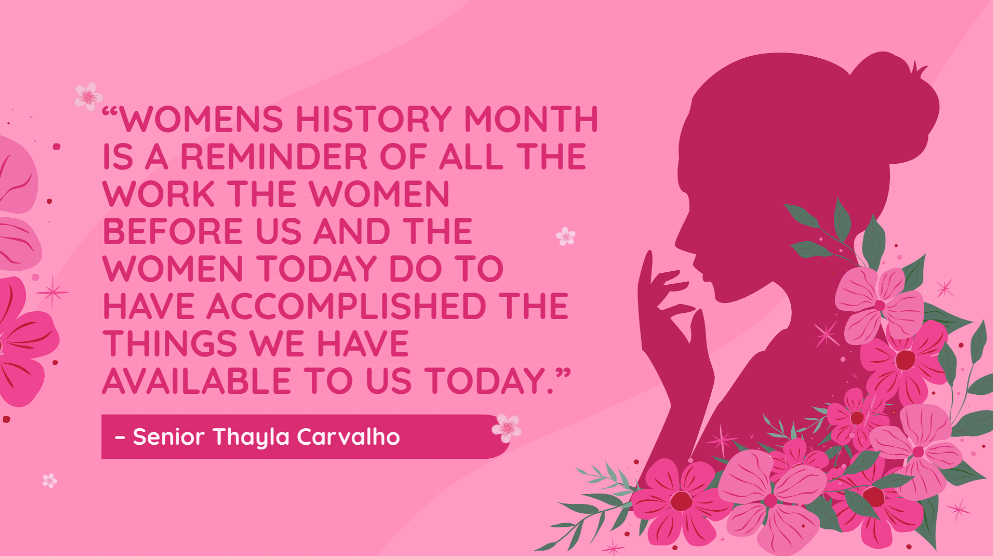
Despite its significance, Women’s History Month is not always given the same amount of attention in schools. While some classrooms may briefly acknowledge it, some feel that it is not as integrated into the curriculum as it should be.
“I don’t think it gets enough recognition,” sophomore Gabriela Castillo expressed, explaining that at most she only received “an assignment on women’s history as extra credit,” not a “major assignment.”
Similarly, sophomore Tara Villatore noted that they “don’t really see teachers… talking about women who made changes,” emphasizing the lack of consistent discussion surrounding women’s contributions.
“People can be very misogynistic still to this day and very sexist,” sophomore David Ruprecht continued, “I feel like [women] face a lot of challenges like sexism in the workfield or getting sexualized or objectified, and being cat called, which is very disrespectful and very wrong. They still have to advocate for their rights, even though they shouldn’t because they should already have their rights, equally as men.”
Beyond history, the influence of women is often most visible in personal lives. Many individuals mentioned how the women they admire are women around them.
“A woman who has influenced my life the most is my mother,” Ruprecht shared, adding that she “has always taught me the right values.” Reflecting the impact of women extends far beyond public achievements and into the shaping of both individuals and communities.
Villatore also mentioned her mother as a woman who inspires her, describing her as one of the “strongest women” she knows.
Women’s History Month is more than a time of reflection and celebration, it is also a call to support women’s fight for equality and proper recognition for their achievements. By learning about the past and acknowledging these recent challenges, we can contribute to a more inclusive and respective society.
As sophomore Edythe Howse explained, the month represents “celebrating women who were brave enough to stand up,” as well as recognizing those who continue to fight for equality today.
For Castillo, this month is for “celebrating women who stood up, women who can’t stand up, women in other countries that feminism hasn’t reached or can’t speak for themselves without repercussions.”
Although progress has been made toward gender equality, many challenges still remain. Women continue to face sexism, unequal treatment, and judgment in both professional and everyday settings. These experiences show that equality has not yet been fully achieved, making awareness and advocacy as important as ever. Through education, awareness, and everyday actions, Women’s History Month serves as a reminder that every voice plays a role in shaping a better future.
About the Author